What Is the Complete AI Automation Engineer Roadmap for 2026?
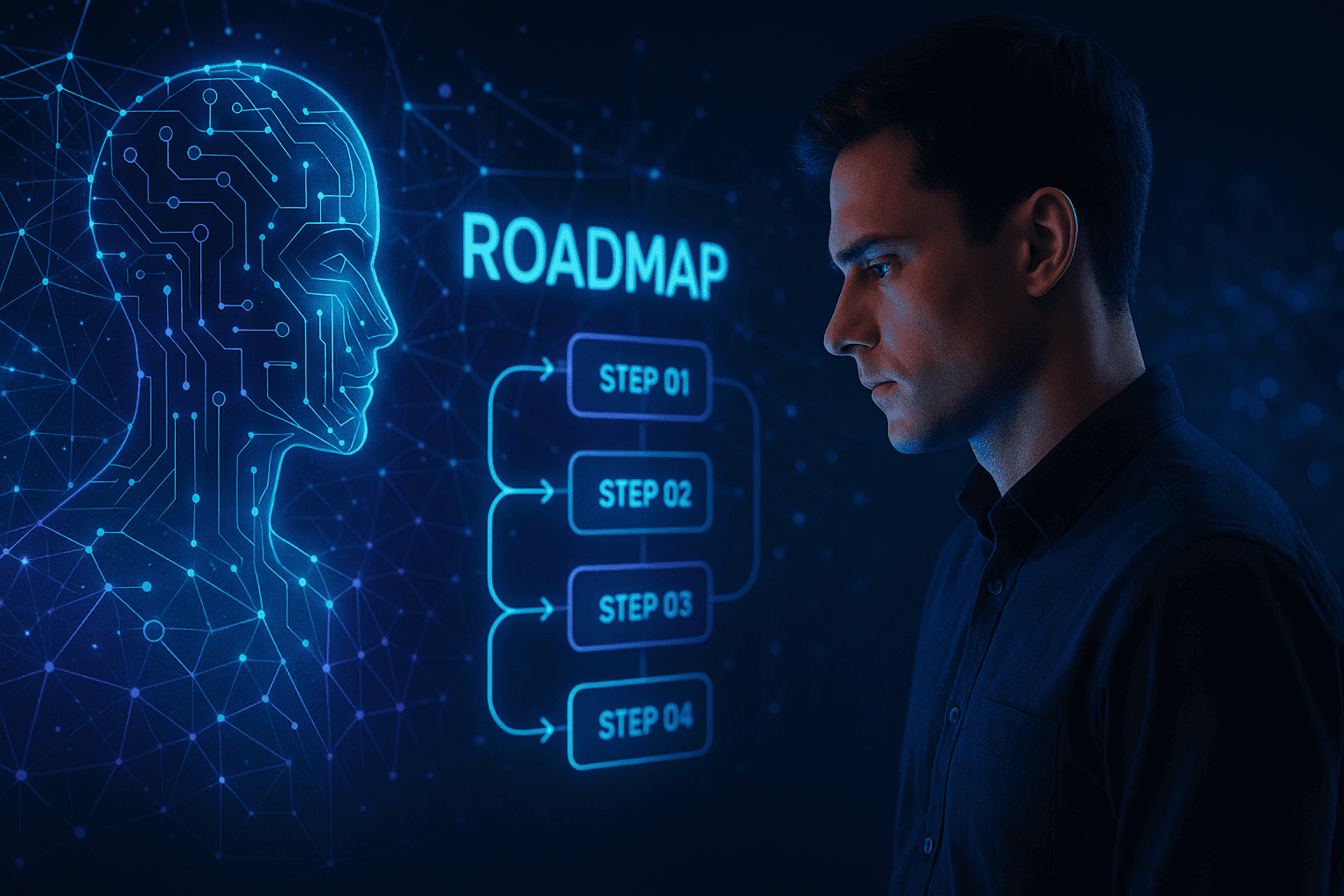
I still remember the day I realized my career was headed toward obsolescence. Not in a dramatic, robots-taking-over way, but in a quiet “oh crap, the industry is moving and I’m standing still” kind of way. I’d been doing traditional backend development for years, comfortable with my APIs and microservices, when a junior developer on my team deployed an automated workflow that used to take our ops team three hours… and it finished in eight minutes. That’s when I knew I needed to pivot into AI automation engineering, and honestly, I had no idea where to start. An ai automation engineer roadmap 2026 is a structured learning path covering Python programming, machine learning fundamentals, automation frameworks like Apache Airflow, LLM integration, and cloud platforms such as AWS or Azure.
Most engineers need 12–18 months to transition into this role, starting with programming basics and progressing through AI model deployment, workflow automation, and production system management. The roadmap emphasizes hands-on projects, certifications like TensorFlow Developer or AWS Machine Learning Specialty, and real-world automation use cases. The AI automation engineer role didn’t even exist five years ago. Now, it’s one of the fastest-growing tech careers with salaries averaging $135,000–$180,000 annually. I’ve watched countless developers struggle to break into AI automation simply because they lacked a clear, step-by-step roadmap that bridges traditional software engineering with modern machine learning operations. This isn’t about becoming a data scientist or a generic DevOps engineer; it’s about mastering the unique intersection of intelligent systems, workflow orchestration, and scalable automation infrastructure. Whether you’re a software engineer pivoting into AI or a complete beginner, this 2025–2026 roadmap will show you exactly what to learn, in what order, and why each skill matters for landing your first (or next) AI automation role.
Why AI Automation Engineering Is the Most In-Demand Tech Role in 2026
In summary, following the ai automation engineer roadmap 2026 is essential for anyone looking to thrive in the evolving tech landscape.
The numbers don’t lie, and they’re kinda wild. According to LinkedIn’s 2025 Emerging Jobs Report, AI automation engineer positions have grown by 342% over the past three years, making it the third fastest-growing tech role globally. The U.S. Bureau of Labor Statistics projects 23% growth through 2032, which is way faster than the average for all occupations. What makes this role so different from traditional software development? Well, I learned this the hard way when I first tried applying my backend development skills directly to AI automation. Traditional software engineering focuses on building deterministic systems—you write code, it produces predictable outputs. AI automation engineering requires you to work with probabilistic systems that learn and adapt, then integrate those intelligent systems into production workflows that need to scale reliably. You’re basically bridging two worlds that speak different languages. The top five industries hiring AI automation engineers right now are:
- Healthcare – Automating diagnostic workflows, patient data processing, and clinical decision support systems
- Finance – Fraud detection pipelines, automated trading systems, and risk assessment workflows
- Manufacturing – Predictive maintenance automation, quality control systems, and supply chain optimization
- E-commerce – Personalization engines, inventory management, and customer service automation
- Logistics – Route optimization, warehouse automation, and demand forecasting systems
These aren’t just corporate buzzwords either. I’ve personally seen healthcare companies automate radiology report generation that used to take radiologists 15-20 minutes per scan down to 90 seconds with AI review. Let’s talk money, because that’s what got my attention initially. Junior AI automation engineers with 0-2 years of specific experience in this niche are pulling in $95,000–$120,000 annually. Mid-level engineers with 3-5 years are seeing $135,000–$180,000, and senior engineers with 6+ years are regularly hitting $200,000–$250,000 plus significant equity packages. In San Francisco and New York, these numbers jump by another 20-30%. Even remote positions are offering competitive salaries in the $140,000–$160,000 range for mid-level folks. Real-world AI automation tasks look pretty different from what you might imagine. You’re not sitting around training models all day like a data scientist. Instead, you’re building intelligent document processing systems that automatically extract, classify, and route invoices through approval workflows. You’re creating predictive maintenance pipelines that analyze IoT sensor data from factory equipment and automatically schedule maintenance before failures occur. You’re deploying conversational AI systems that handle customer service tickets, escalate complex issues to humans, and continuously learn from interactions. Why are companies prioritizing automation engineers over other AI roles right now? Because they’ve got data scientists who can build amazing models that sit in Jupyter notebooks gathering dust. What they desperately need is someone who can take those models, wrap them in reliable automation frameworks, deploy them to production environments, and ensure they keep running smoothly at scale. That’s the million-dollar skill gap, and it’s why this role is exploding.
What Programming Languages Should You Master First?
Python is absolutely non-negotiable. I tried to be clever early on and focus on Julia because I read an article about it being “the future of scientific computing.” That was dumb. Python dominates AI automation for three massive reasons: the ecosystem of libraries is unmatched, the community support means you can find solutions to basically any problem, and the syntax is simple enough that you can focus on learning automation concepts rather than fighting with language complexity. When I finally committed to Python, I spent three months going deep on the fundamentals. That timeline isn’t random—it’s what it actually takes if you’re starting from scratch and dedicating 15-20 hours weekly. You need to understand object-oriented programming, decorators, context managers, async/await patterns for handling concurrent operations, and error handling that doesn’t bring down production systems. The essential Python libraries for automation became my daily toolkit. Pandas for data manipulation (you’ll use this constantly for processing datasets before feeding them into models). NumPy for numerical operations that underpin basically all machine learning math. Scikit-learn for implementing traditional ML algorithms quickly without reinventing the wheel. And you need at least basic familiarity with TensorFlow or PyTorch for deep learning work, though you don’t need to be an expert initially. Here’s my recommended learning timeline for Python proficiency: 3–4 months if you’re starting completely from scratch with consistent daily practice. If you already know another programming language, you can probably cut this to 6-8 weeks. But don’t rush it, weak Python fundamentals will bite you hard later when you’re debugging complex automation pipelines at 2 am. JavaScript and TypeScript threw me for a loop because I initially thought they were unnecessary. Wrong again. Turns out, lots of AI automation involves building interfaces for non-technical stakeholders to interact with your systems, and most of those interfaces are web-based. You also need JavaScript for API integrations, webhook handlers, and sometimes for building lightweight automation scripts that run in serverless environments. I’d say get comfortable with JavaScript after you’ve got solid Python skills, probably around month 5-6 of your learning journey. SQL and database management fundamentals are absolutely critical, and this is where many developers stumble. Your AI models need data, and that data lives in databases. You need to write efficient queries, understand indexes, know how to structure data pipelines that pull from multiple sources, and grasp when to use relational databases versus NoSQL solutions. I spent probably 40 hours just getting comfortable with complex joins and subqueries, and it paid off immediately when I started building real pipelines. When should you learn additional languages like Go or Rust? Honestly, not until you’re solid with Python, JavaScript, and SQL. Go becomes valuable when you’re building performance-critical components of automation systems—things like custom API gateways or high-throughput data processors. Rust is even more specialized, typically for systems programming or when you need absolute maximum performance. These are “nice to have” skills that you can pick up later when specific projects demand them. My first real hands-on project was building a web scraper that collected job postings from various sites, extracted key information, and fed that data into a simple machine learning classifier that categorized positions by seniority level and skill requirements. It was messy, it broke constantly, and I learned more from that one project than from three online courses combined. Start building something imperfect early rather than waiting until you feel “ready.”
How Do You Build Core Machine Learning and AI Skills?
Supervised versus unsupervised learning—I spent way too long getting hung up on the theoretical differences before realizing what actually matters for automation workflows. Supervised learning (where you train models on labeled data) is what you’ll use most frequently for automation tasks. Classification problems like “is this customer service email angry or neutral?” and regression problems like “what will our server load be in three hours?” are bread-and-butter automation use cases. Unsupervised learning (clustering, anomaly detection) comes in handy for things like automatically grouping similar support tickets or detecting unusual system behavior without predefined rules. Deep learning fundamentals took me about two months to grasp at a practical level. You need to understand how neural networks actually work—layers, activation functions, backpropagation—but you don’t need a PhD-level grasp of the mathematics. Focus on understanding training loops (how models learn from data), loss functions (how we measure model performance), and evaluation metrics (precision, recall, F1 score, AUC). I made flashcards for these concepts because they’re easy to confuse under pressure. Natural language processing basics became crucial when I started automating document workflows. You need to understand tokenization, embeddings, basic text classification, and sentiment analysis. The cool thing is that in 2025, you don’t need to build complex NLP systems from scratch—you can use pre-trained language models through APIs. But you do need to understand how to fine-tune them, evaluate their outputs, and build automation workflows around them. I built a simple document classification system that automatically sorted incoming emails into categories, and that project taught me more about practical NLP than any textbook. Computer vision essentials matter if you’re working with image-based automation. Optical character recognition (OCR) for extracting text from documents, object detection for identifying items in images, and basic image classification are the core skills. I worked on a project that automated invoice processing by using OCR to extract text, then feeding that text into a classifier that identified invoice fields—it was incredibly satisfying when it finally worked. The five ML algorithms every AI automation engineer must understand are:
- Linear Regression – For predicting continuous values like resource usage or demand forecasts
- Decision Trees – For classification problems with clear decision boundaries, easy to explain to stakeholders
- Random Forests – For more robust classification when you need better accuracy than single decision trees
- Neural Networks – For complex pattern recognition in images, text, or sequential data
- Clustering (K-means) – For unsupervised grouping of similar items without predefined categories
Here’s the practical approach that saved me months of frustration: start with pre-trained models before building anything from scratch. There’s no shame in using a pre-trained BERT model for text classification or a pre-trained ResNet for image recognition. Once you understand how to deploy and use these models in automation workflows, start experimenting with training your own. This approach gets you producing value much faster. For courses and certifications, Andrew Ng’s Machine Learning Specialization on Coursera gave me the theoretical foundation I needed. Fast.ai taught me practical deep learning with a code-first approach that clicked with my brain. Google’s ML Crash Course is completely free and covers fundamentals quickly. I did all three over about five months, doing the exercises religiously, even when I was tired.
What Automation Frameworks and Tools Are Essential in 2026?
Apache Airflow completely changed how I thought about automation. Before Airflow, I was writing janky cron jobs and custom scripts that were impossible to monitor or debug. Airflow introduces the concept of DAGs (Directed Acyclic Graphs). Basically, visual representations of your workflows showing dependencies between tasks. You can schedule complex pipelines, monitor their execution, retry failed tasks, and see exactly where things break. I spent three weeks just learning Airflow basics, and it’s now something I use almost daily. Kubernetes and Docker were intimidating at first because I came from a background where deployment meant “upload files to a server.” Containerization with Docker lets you package your AI applications with all their dependencies into portable units that run consistently anywhere. Kubernetes orchestrates those containers at scale, handling things like load balancing, auto-scaling, and recovery from failures. These aren’t optional skills anymore—pretty much every production AI system I’ve worked on uses containerization. The top seven must-know automation tools for 2025 are:
- Apache Airflow – Workflow orchestration and scheduling for complex pipelines
- Prefect – Modern alternative to Airflow with easier debugging and better Python integration
- Kubeflow – Machine learning workflow orchestration specifically designed for Kubernetes environments
- MLflow – Model versioning, experiment tracking, and deployment management
- Jenkins – CI/CD automation for testing and deploying ML models
- Terraform – Infrastructure as Code for reproducible cloud environments
- Ansible – Configuration management and deployment automation
CI/CD pipelines for ML models are different from regular software CI/CD, and this tripped me up initially. You’re not just testing code—you’re validating model performance, checking for data drift, ensuring predictions stay within acceptable ranges, and versioning not just code but also training data and model artifacts. I built my first ML pipeline using GitHub Actions to automatically retrain a model when new data arrived, run validation tests, and deploy only if performance metrics improved. It failed the first five times spectacularly before I got it working. Low-code and no-code automation platforms like Zapier, Make (formerly Integromat), and n8n have their place in an AI automation engineer’s toolkit. I was skeptical at first—why use these when I can code everything? But they’re incredibly useful for rapid prototyping, building simple integrations between services, and creating automations for non-technical stakeholders. I use n8n for personal productivity workflows and have even integrated it with custom ML models through webhooks. Monitoring and observability tools became critical once I had systems running in production. Prometheus for collecting metrics, Grafana for visualizing them, and DataDog for comprehensive monitoring across distributed systems—these tools help you catch problems before they become disasters. I set up alerts that notify me when model prediction latency spikes or when error rates exceed thresholds. Nothing teaches you the value of monitoring like getting paged at midnight because a production model is returning garbage predictions. My hands-on project exercise that ties everything together: build an end-to-end automated data pipeline that ingests data from an API, processes it with Pandas, trains a simple classification model with Scikit-learn, deploys the model using Docker, schedules regular retraining with Airflow, and monitors performance with Prometheus. This single project touches almost every tool you’ll use professionally and gives you something concrete to show employers.
How to Master Cloud Platforms for AI Automation
The AWS versus Azure versus Google Cloud debate almost paralyzed me with indecision. Here’s the practical reality: AWS has about 40% of the cloud market and appears in the most job postings, so if you’re optimizing purely for job opportunities, start there. Azure is strong in enterprise environments, and if you’re already in a Microsoft ecosystem, it makes sense. Google Cloud has excellent ML-specific tools but fewer general automation job listings. I chose AWS initially and don’t regret it. Essential AWS services for AI automation became my daily toolkit. SageMaker for building, training, and deploying ML models without managing infrastructure. Lambda for serverless functions that respond to events (like new data arriving). Step Functions for orchestrating complex workflows visually. S3 for storing everything literally—datasets, model artifacts, logs. EC2 and ECS for running containerized applications when serverless doesn’t fit. Learning how these services connect took me about six weeks of hands-on experimentation. Azure-specific tools I learned later when a project required it: Azure Machine Learning for end-to-end ML workflows, Logic Apps for workflow automation (similar to AWS Step Functions), Azure Functions for serverless computing, and Cognitive Services for pre-built AI APIs. The concepts transfer pretty well between cloud providers once you understand one platform deeply. Expected timeline for cloud proficiency: 2–3 months to gain intermediate skills with one major platform if you’re practicing 10-15 hours weekly. “Intermediate” means you can deploy applications, set up basic infrastructure, understand pricing models, and troubleshoot common issues. Expert-level cloud skills take years, but you don’t need that to be job-ready. Infrastructure as Code with Terraform was a game-changer for reproducibility. Instead of clicking through cloud consoles and hoping you remember the configuration, you define your infrastructure in code files that can be version-controlled and deployed consistently. I can now spin up identical development, staging, and production environments with a single command. It took me three weeks to get comfortable with Terraform basics, but it’s saved countless hours since. Cost optimization became important fast when I got my first AWS bill and nearly had a heart attack. Running AI workloads in the cloud gets expensive quickly if you’re not careful. Use spot instances for training jobs that can tolerate interruptions. Shut down resources when not in use (I wrote Lambda functions to automatically stop EC2 instances outside business hours). Use appropriate instance types; You don’t need a GPU instance for data preprocessing. Monitor costs with billing alerts. I’ve seen companies waste thousands monthly on forgotten test resources. Certification paths provide structure and credibility. AWS Certificate
Continue Your AI Automation Journey
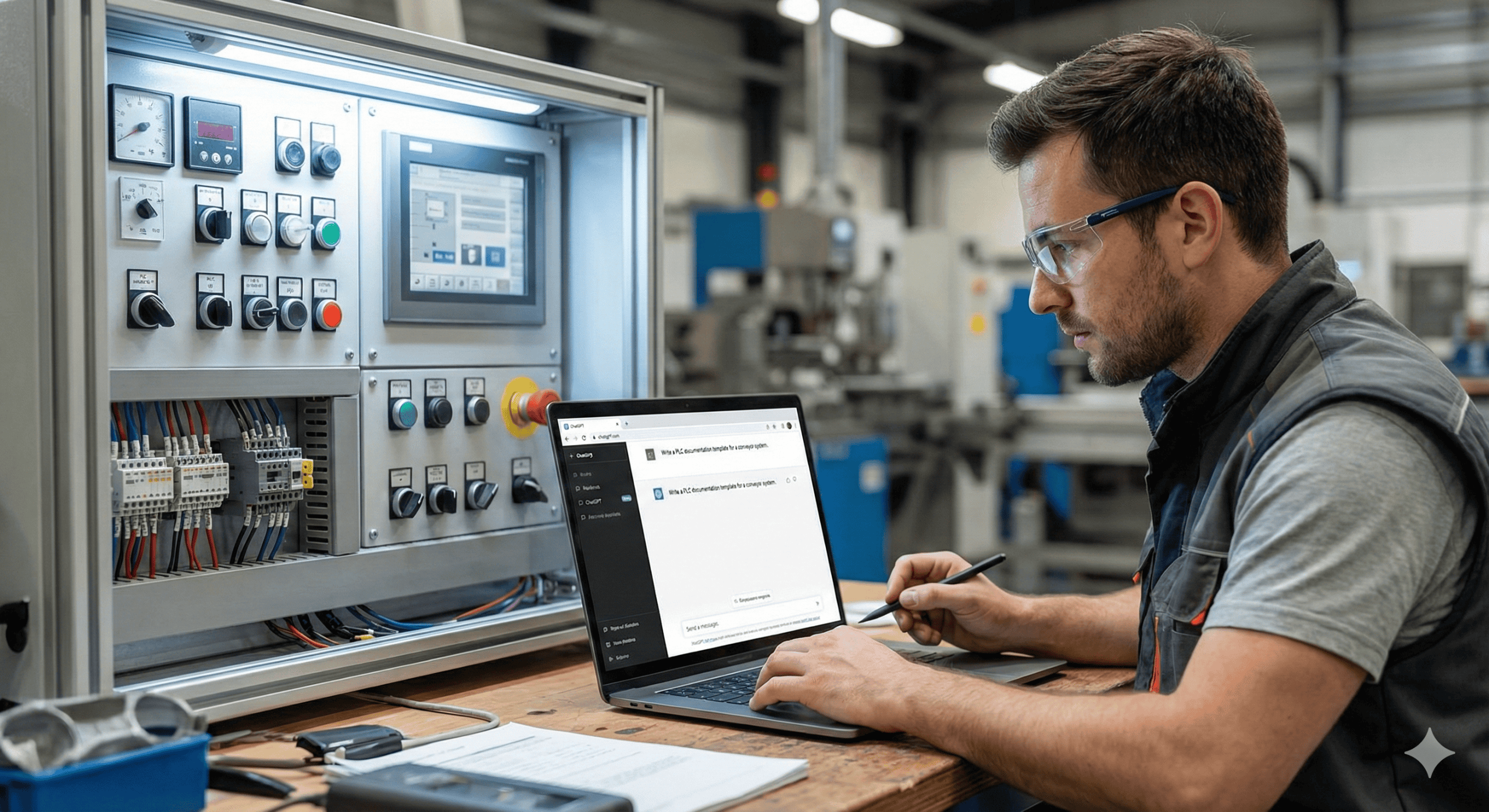
Now that you have the complete roadmap, here are practical next steps to accelerate your progress. If you want to see how working automation engineers are already using AI tools on the job, read our guide on ChatGPT for Industrial Automation Engineers — it covers real prompts and workflows you can use today, even while you are still building your foundational skills.
If you are not sure where to begin based on your current experience level, our Start Here page will point you to the right resources. And if you are looking for hands-on consulting support for integrating AI into your automation systems, learn about how we work with engineering teams.
About the Author
Bernard Mudafort is a practicing industrial automation engineer with over 25 years of hands-on experience in PLC programming, SCADA systems, and control systems engineering across pharmaceutical manufacturing, food processing, and heavy industry. He founded AI Automation Insider to help working engineers practically integrate AI into real industrial automation environments. Connect with Bernard on the About page or explore how he works with engineering teams.
How long does it take to become an AI automation engineer?
Most engineers need 12 to 18 months to make the transition, starting with Python programming and progressing through machine learning, automation frameworks like Apache Airflow, and cloud platforms. If you already have a software engineering background, you can cut the timeline to 8 to 12 months with focused study of 15 to 20 hours per week.
What is the average salary for an AI automation engineer in 2026?
Junior AI automation engineers earn $95,000 to $120,000 annually, mid-level engineers with 3 to 5 years of experience earn $135,000 to $180,000, and senior engineers with 6 or more years regularly hit $200,000 to $250,000 plus equity. Remote positions typically offer $140,000 to $160,000 for mid-level roles.
Do I need a degree in computer science to become an AI automation engineer?
No. While a CS degree helps, many successful AI automation engineers come from traditional software development, DevOps, or industrial engineering backgrounds. What matters most is hands-on proficiency with Python, machine learning fundamentals, and automation frameworks, all of which can be learned through online courses, certifications, and real-world projects.
Which cloud platform should I learn first for AI automation?
Start with AWS if you are optimizing for job opportunities because it holds roughly 40 percent of the cloud market and appears in the most job postings. Azure is strong in enterprise environments, and Google Cloud excels with ML-specific tools. The core concepts transfer well between platforms once you master one.