ChatGPT for Industrial Automation Engineers | A Practical 2026 Guide
By Bernard Mudafort | 25-Year Automation Veteran | Updated February 2026
When ChatGPT first appeared, my reaction was probably the same as yours: skeptical.
I’ve spent 25 years in industrial automation: PLC programming, SCADA systems, DeltaV, Rockwell, and FDA-regulated manufacturing. I’ve seen many technology trends come through the industry. Most of them promised more than they delivered.
FREE GUIDE
Stop Writing Design Specs by Hand
Get the free visual guide: how AI tools generate GAMP 5 documentation directly from your PLC and DCS exports. Used by Life Sciences engineers who are done doing it manually.
No spam. Unsubscribe anytime.
This one is different.
After using ChatGPT daily for over a year on real automation projects, from writing ladder logic documentation to troubleshooting fault conditions on pharmaceutical manufacturing lines, I can tell you it’s the most useful addition to my engineering workflow in the past decade.
This guide covers exactly how to use ChatGPT as a working automation engineer. No hype. No theory. Just practical applications with real prompts you can use today, whether you’re a seasoned controls engineer or just getting started in the field.
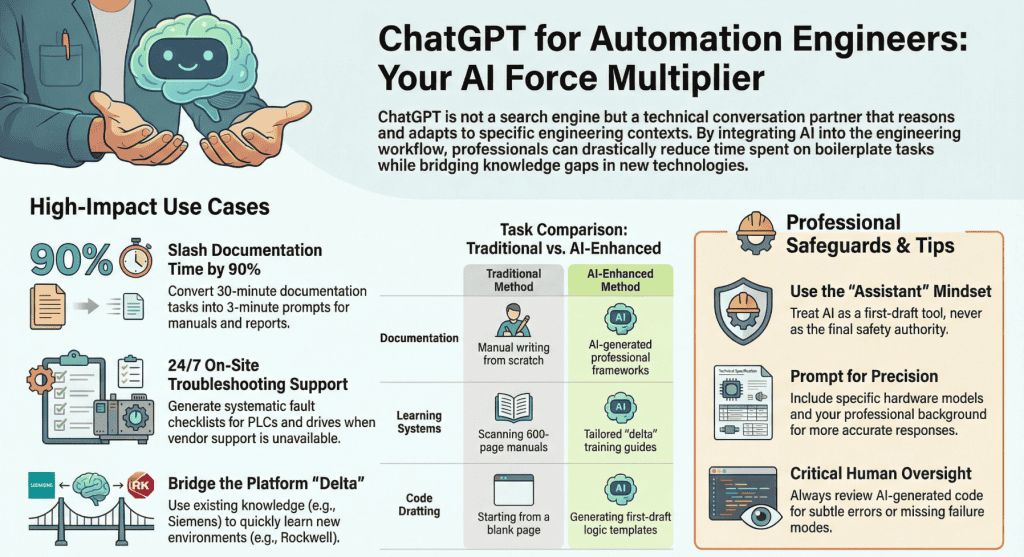
TL;DR: ChatGPT is a practical daily tool for industrial automation engineers — not hype. The six highest-value applications are: PLC documentation (30-minute tasks cut to 3), on-site troubleshooting support, cross-platform learning, technical spec generation, predictive maintenance concepts, and ST code templates. The free tier handles most use cases. Always review generated code before deployment on live systems. Automation engineers who use AI tools effectively will outperform those who do not.
Key Takeaways: ChatGPT for Industrial Automation Engineers
- ChatGPT will not replace experienced automation engineers. But engineers using it effectively will outperform those who do not — in speed, documentation quality, learning agility, and project range.
- The six highest-ROI applications for working engineers: documentation drafting, troubleshooting support, platform cross-training, spec generation, AI concept learning, and code templates.
- Always tell ChatGPT your platform and background upfront. “I am an experienced DeltaV engineer” gets you a fundamentally different and more useful response than a generic query aimed at a general audience.
- ChatGPT can be confidently wrong. Never trust it for safety-critical decisions without cross-referencing official documentation and your own judgment.
- The free tier is sufficient for most use cases. ChatGPT Plus at $20 per month is worth it for complex, multi-step technical queries that require the more capable models.
- Documentation tasks that used to take 30 minutes now take 3. On a large project, that difference translates to real billable hours recovered.
What Is ChatGPT and Why Does It Matter for Industrial Automation Engineers?
ChatGPT is a large language model (LLM) — an AI system trained on an enormous body of text. In practical terms, it means you can describe a technical problem, a documentation task, or a concept in plain English, and it will generate a structured, useful response.
It is not a search engine. It doesn’t retrieve pages written by someone else. It reasons, writes, explains, and generates responses tailored to the specific context you give it.
For engineers, that distinction matters. You’re not Googling for an answer that may or may not fit your situation. You’re having a technical conversation with a tool that adapts to your specific platform, system, and background.
It gets things wrong sometimes, but we’ll cover that. Used correctly, ChatGPT is a genuine force multiplier for automation work.
6 Ways Automation Engineers Are Using ChatGPT Right Now
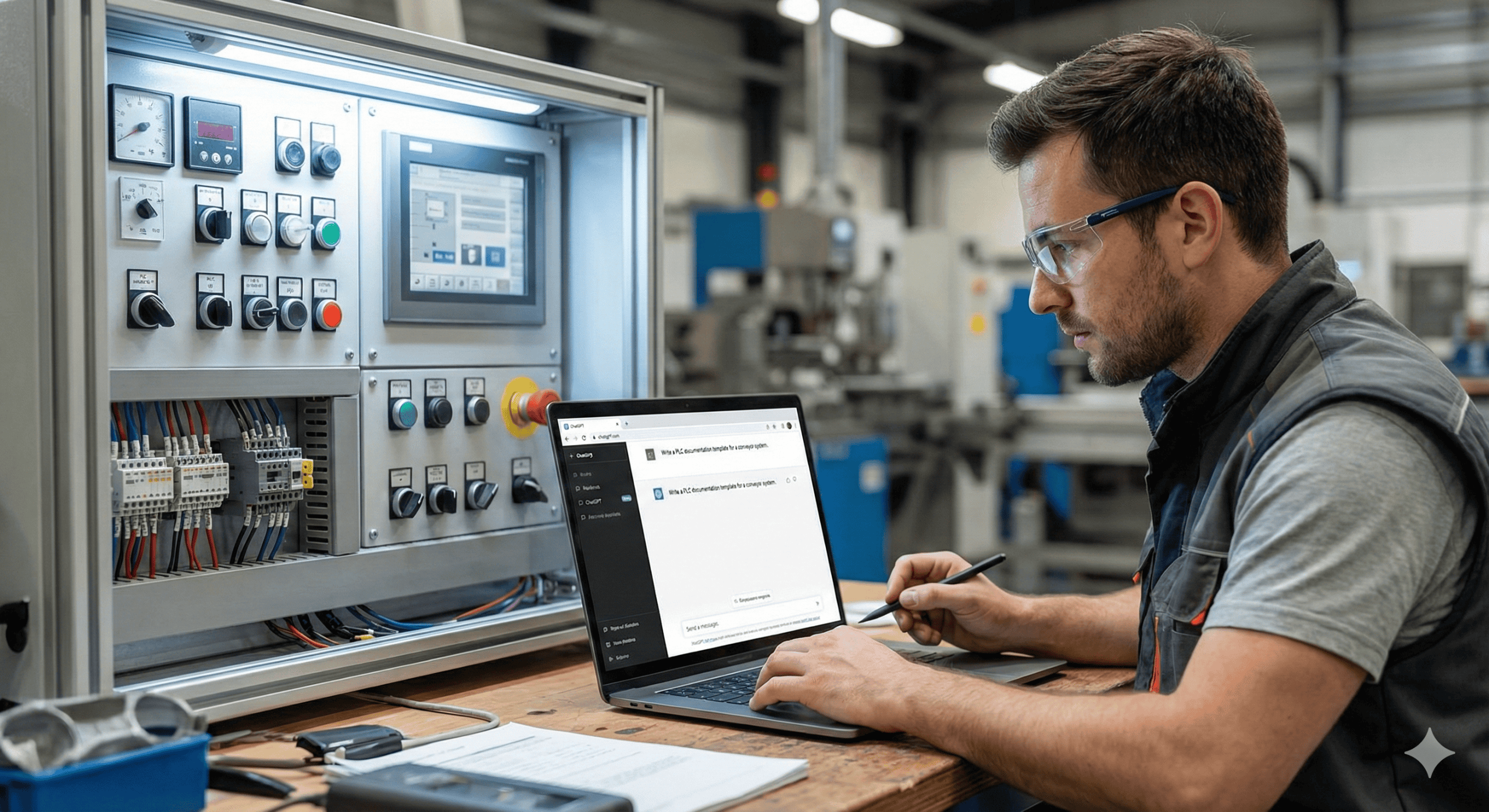
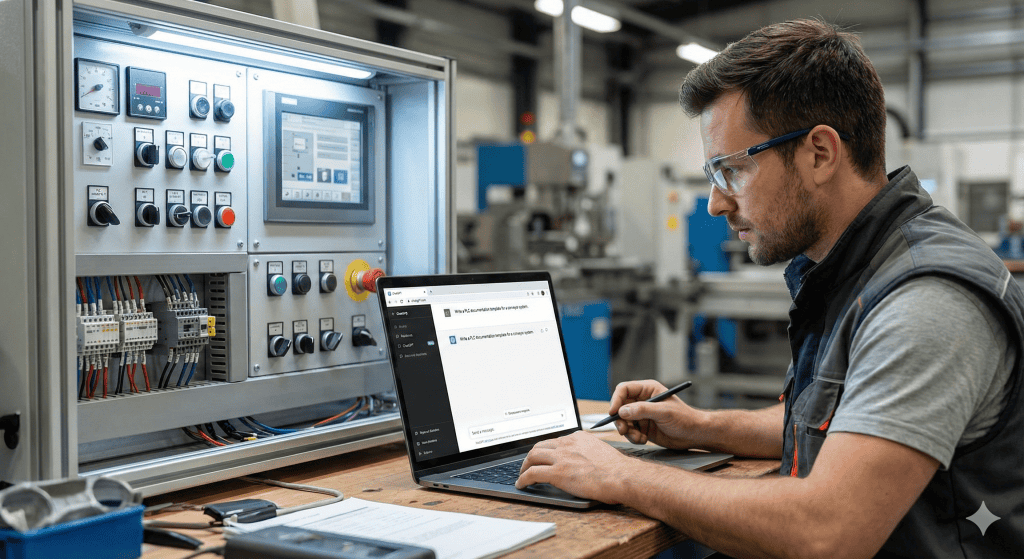
1. Writing PLC Documentation Faster Than Ever
Documentation is one of the most time-consuming and least-enjoyed parts of any automation project. Whether it’s a FAT package, an O&M manual, or a routine change description, it pulls you away from the actual engineering work.
ChatGPT won’t write your ladder logic — but it will document it clearly, consistently, and quickly.
Try this prompt:
I have a PLC routine that controls a conveyor start/stop sequence with safety interlocks on a food packaging line. Write a clear technical description suitable for an operations manual.
Include sections for: purpose, inputs and outputs, interlock logic, and operating conditions.
My I/O tags are: [paste your tag list here].
What used to take 30 minutes takes 3. And the output is cleaner and more consistent than most of us write after a long site day.
You can also use ChatGPT to:
- Rewrite poorly documented legacy code descriptions from older engineers
- Generate consistent naming convention guides for a project
- Create structured fault code reference tables for operator use
- Draft I/O list header sections for new projects
2. On-Site Troubleshooting Support
You’re on-site at 2 am. A fault you haven’t seen before. Your vendor support line goes to voicemail. Your experience gets you most of the way there, but you want to make sure you’re not missing something obvious.
This is where ChatGPT earns its keep.
Try this prompt:
A Siemens S7-1200 PLC is faulting on a VFD during ramp-up.
The drive trips on overcurrent at approximately 60% speed.
Motor: 15kW, 4-pole induction, driving a centrifugal pump.
What are the most likely causes and what should I check first?
ChatGPT will surface a systematic checklist of possibilities — motor sizing, ramp time parameters, current limit settings, mechanical load issues — faster than you could scan through a drive manual.
It won’t replace your site knowledge or your experience. But it acts like a knowledgeable colleague you can think out loud with, any time of day.
For DeltaV engineers: You can also paste alarm descriptions, ask for ISA-18.2-aligned rationalization language, or request alarm prioritization frameworks based on your consequence descriptions.
3. Learning New Platforms Without Starting from Scratch
Every engineer eventually gets assigned to a platform they haven’t worked on before. Traditionally, that means manuals, forums, trial and error, and weeks of slow learning.
ChatGPT compresses that timeline dramatically because it understands your existing context and can teach you the delta, not the whole subject.
Try this prompt:
I'm an experienced DeltaV engineer who has just been assigned to a Rockwell Studio 5000 project. Explain the key differences I need to be aware of, and give me a practical getting-started guide focused on someone with my background.
Focus on: project structure, tag database, function blocks, and HMI integration.
Because you’ve given it your background, it doesn’t explain what a function block is from scratch. It explains how Studio 5000’s implementation differs from what you already know. That’s something no manual or YouTube tutorial can do.
4. Writing Technical Specifications and Deliverables
Project specs, URS documents, FDS templates, commissioning protocols, method statements — these are standard deliverables that consume significant engineering hours.
ChatGPT won’t know your site-specific details. But it can give you a complete professional structure in under a minute, and fill in all the boilerplate language that’s the same on every project.
Try this prompt:
Write a technical specification template for a PLC-controlled conveyor system in an FDA-regulated pharmaceutical manufacturing environment.
Include sections for: scope, design requirements, I/O specification, 21 CFR Part 11 compliance requirements, safety requirements, testing and commissioning, and documentation deliverables.
Use it as your starting framework. Drop in the project-specific content. You’ll cut first-draft time by at least half, which on a large project translates to real billable hours saved or recovered.
5. Understanding AI and Predictive Maintenance Concepts
The automation industry is moving fast toward predictive maintenance, computer vision quality control, and AI-assisted process optimization. These are going to appear in more projects, more RFPs, and more client conversations over the next three years.
The problem: most AI learning resources are written for data scientists, not engineers.
ChatGPT bridges that gap by explaining concepts in the language and analogies you already know.
Try this prompt:
Explain how machine learning-based predictive maintenance works for rotating equipment in a manufacturing plant. Explain it as if you're talking to an experienced PLC engineer with no background in data science. Use analogies to concepts I would already know from control systems engineering.This is one of the highest-value uses of ChatGPT for working automation engineers right now, not just for doing the job, but for career positioning and client conversations.
6. Generating Code Snippets and Logic Templates
ChatGPT can generate Structured Text (ST) code, ladder logic pseudocode for planning purposes, Python scripts for data handling from historians, and shell scripts for system utilities.
Try this prompt:
Write a Structured Text function block in IEC 61131-3 that implements a timer-based sequential start of three motors with a 5-second delay between each. Include fault detection for each motor start confirmation, with a fault output bit and descriptive alarm text for each failure mode.Important caveat: Always review and test any generated code before using it in a live system. ChatGPT can produce code with subtle errors, incorrect timer data types, missing edge detection, or logic that doesn’t account for a failure mode you know from experience is common on your site.
Use it as a fast first draft, not a finished product. Even an imperfect starting point is faster than a blank page.
What ChatGPT Cannot Do | Honest Limitations
Being clear about limitations is what makes this tool useful rather than dangerous.
It cannot access your systems. ChatGPT has no connection to your PLCs, DCS, SCADA, historian, or network. All context comes from you. It only knows what you tell it.
It can be confidently wrong. ChatGPT sometimes states incorrect information with complete confidence. Never trust it for safety-critical decisions without cross-referencing against official documentation and your own judgment.
It doesn’t know your site. Every plant has unique quirks, history, and configuration. ChatGPT gives general engineering knowledge; the site-specific judgment is always yours.
It has a knowledge cutoff. Its training data doesn’t include the latest firmware updates, recent product releases, or bulletins issued in the past several months. For current platform-specific issues, check the vendor’s knowledge base directly.
Use ChatGPT as a powerful assistant, not as the final authority on anything that matters.
How to Get Better Results: Prompt Tips for Automation Engineers
The quality of ChatGPT’s output is directly tied to the quality of your input. Three principles that make an immediate difference:
Be specific about your platform and context. Don’t say “help me with a PLC fault.” Say: “I have a Siemens S7-300 CPU 315-2DP showing a hardware interrupt fault on Profibus DP at slave address 5. The slave is an ET200S I/O module running a 4-20mA analog input card.”
Tell it your background upfront. Starting with “I’m an experienced automation engineer with 15 years on Rockwell platforms” will get you a fundamentally different and more useful response than a default answer aimed at a general audience.
Ask it to structure the output. “Give me this as a numbered troubleshooting checklist”, or “format this as a table”, or “write this in the style of a formal engineering specification” will produce output you can use immediately rather than output you have to reformat.
Getting Started Today
You don’t need a paid account to start. ChatGPT’s free tier handles most of what’s described in this guide.
If you want access to the more capable models, which handle complex, multi-step technical questions more reliably, ChatGPT Plus is $20/month. For regular professional use, it’s worth it.
Start here:
- Go to https://chat.openai.com
- Create a free account
- Take one of the prompts from this guide and apply it to a real problem you’re working on right now
The fastest way to understand what this tool can do for your engineering work is to use it on something real, not a demo problem, but an actual project task on your desk today.
Final Thought
AI isn’t going to replace automation engineers. The job requires physical presence, system-specific knowledge, hard-won judgment, and the kind of accountability that comes from being the person whose name is on the drawing.
But automation engineers who use AI tools effectively will outperform those who don’t — in speed, documentation quality, learning agility, and the range of projects they can take on.
ChatGPT is the most accessible entry point into that shift. And starting with a single real prompt is all it takes to see why.
Ready to go deeper? Visit the Start Here page to find the right resources for where you are in your automation career.
Working on a project that could benefit from AI-integrated automation consulting? See how I work with engineering teams.
Is ChatGPT safe to use on FDA-regulated automation projects?
ChatGPT is safe to use as a documentation and knowledge support tool in regulated environments, provided you treat its output the same way you would treat input from a junior engineer: review, verify, and sign off before anything reaches a system or a deliverable. It has no connection to your systems and cannot make changes to your infrastructure. For GMP or 21 CFR Part 11 environments, generated documents should be reviewed for accuracy and compliance by a qualified engineer before inclusion in any validated deliverable. The risk is not the tool — it is skipping the verification step.
What is the best ChatGPT model for automation engineering work?
GPT-4o (available on the free tier with usage limits) handles most automation engineering use cases well, including documentation drafting, troubleshooting checklists, and specification templates. For complex multi-step queries — such as generating a full commissioning protocol structure or explaining advanced control theory — the more capable models available on ChatGPT Plus produce noticeably better results. For daily use, start free and upgrade if you find yourself hitting the quality ceiling on technical depth or multi-step reasoning tasks.
Can ChatGPT help with DeltaV DCS programming and configuration?
Yes, with caveats. ChatGPT has working knowledge of DeltaV DCS concepts including control modules, phase logic, named sets, and ISA-88 batch structures. It can help you draft module descriptions, explain ISA-18.2 alarm rationalization approaches, and translate concepts between DeltaV and other platforms like Studio 5000 or Siemens TIA Portal. Where it falls short is on version-specific behaviors, recent Emerson software updates, and site-specific configuration details it cannot know. Use it as a knowledgeable starting point and verify against the Emerson documentation and your site configuration before acting on anything platform-specific.
Ready to Go Deeper?
If you are serious about building AI into your automation career, our Complete AI Automation Engineer Roadmap for 2026 lays out the full learning path from Python fundamentals through cloud deployment and production systems. It covers everything you need to know about skills, certifications, salary expectations, and the step-by-step order to learn it all.
Visit the Start Here page to find the right resources for where you are in your automation career. If you need hands-on tools and recommended platforms, check out our Resources page.
About the Author
Bernard Mudafort is a practicing industrial automation engineer with over 25 years of hands-on experience in PLC programming, SCADA systems, and control systems engineering across pharmaceutical manufacturing, food processing, and heavy industry. He founded AI Automation Insider to help working engineers practically integrate AI into real industrial automation environments. Connect with Bernard on the About page or explore how he works with engineering teams.
Can ChatGPT write PLC code?
ChatGPT can generate Structured Text code snippets, ladder logic pseudocode, and Python scripts for data handling. However, you should always review and test any generated code before using it in a live system. It works best as a fast first draft rather than a finished product.
Is ChatGPT reliable for troubleshooting industrial automation faults?
ChatGPT is useful as a troubleshooting companion that surfaces systematic checklists of possible causes. It does not replace your site knowledge or experience, but it acts like a knowledgeable colleague you can think out loud with at any time of day. Always cross-reference its suggestions against official documentation.
Do I need ChatGPT Plus for industrial automation work?
The free tier handles most of the use cases described in this guide. ChatGPT Plus at $20 per month gives you access to more capable models that handle complex multi-step technical questions more reliably, which is worth it for regular professional use.
How do I get better responses from ChatGPT for automation engineering?
Three principles make an immediate difference. Be specific about your platform and context. Tell ChatGPT your background upfront so it calibrates the response to your experience level. And ask it to structure the output in a format you can use immediately, such as a numbered checklist or a formal specification.